In short: Calculating the true cost per barrel of bourbon requires tracking more than just grain and wood. Distilleries must factor in fully burdened labor, production overhead, insurance, taxes, and multi-year aging expenses. Dividing these accumulated costs by the final yield after evaporation reveals your true cost per proof gallon.
Calculating the true cost per barrel of bourbon is one of the most critical financial exercises a distillery owner will undertake. Too often, distilleries calculate their cost by simply adding up the raw materials, the yeast, and the physical oak barrel. While that gives you a quick baseline, it leaves out the massive hidden costs of labor, utilities, facility overhead, and the financial weight of aging whiskey over several years. If you underprice your bottles because your barrel cost calculation was incomplete, your profit margins will vanish before you even start pouring. To build a sustainable brand, you must track every dollar that goes into your liquid from the grain silo to the bottling line.
The bourbon industry is heavily capital intensive. You are putting money into a barrel today and waiting years to see a return. During that waiting period, costs continue to accumulate. Understanding these costs is not just an accounting exercise. It dictates your wholesale pricing, your retail strategy, and your overall cash flow management.
What makes up the direct materials and the mash bill?
The most straightforward place to begin your calculation is with your direct materials. This category includes the grains in your mash bill, proprietary yeast strains, enzymes, and any water treatment required for your mashing process. Water is the largest ingredient by volume in bourbon. If you utilize reverse osmosis systems, carbon filters, or pay municipal water premiums, those filtration costs are direct materials. You must accurately capture the invoice price of these ingredients and allocate them to the specific batches produced.
Ordering grain in bulk silos versus individual fifty-pound bags will fundamentally change your raw material cost. A bulk delivery might cost less per pound, but you must factor in the electricity for the auger and the maintenance of the silo. If a specific cook yields a set number of barrels, you simply divide the total material cost of that batch by the number of barrels produced.
However, direct materials go far beyond the liquid itself. You must not forget the true cost of the cooperage. New charred oak barrels are a massive line item for any bourbon producer. The cost includes the physical barrel, the bung, and the freight required to get those barrels delivered to your loading dock. Freight is a notoriously volatile expense that must be baked into your per-barrel material cost to remain accurate. If you pay a premium for a specific char level, seasoned wood, or custom toasted heads, those costs must also be attached to the specific lot of barrels you fill.
It is also vital to account for material losses during the production process. Spilled grain, yeast that failed to pitch properly, or a faulty barrel that leaks upon filling all represent sunk costs. These losses must be absorbed by the surviving barrels in that batch to reflect reality. Utilizing dedicated production tracking software can help automate these complex material allocations so nothing slips through the cracks.
Tracking direct labor beyond the still
Labor requires a high degree of operational discipline to track accurately. You need to account for the actual hours spent on every step of the active production process. This includes grain handling, milling, mashing, monitoring the fermenters, running the still, and filling the barrels. It also includes the vital cleaning and sanitation hours required between runs, as well as routine maintenance on the boiler and chiller. It even includes the time spent in the lab measuring specific gravity, proofing down spirits, and maintaining detailed logs.
To calculate this effectively, multiply your production hours by the fully burdened hourly rate of your staff. Fully burdened means including payroll taxes, benefits, workers compensation, and insurance. It is not just their base wage. For instance, if a distiller spends ten hours managing a run, and their burdened rate is calculated, that entire sum must be allocated to the barrels yielded from that specific run. Divide that total burdened labor cost by the number of barrels yielded from the production run.
In a growing distillery, staff members often wear multiple hats. A worker might spend the morning mashing in, the afternoon giving tours, and the evening cleaning the tasting room. Only the labor hours dedicated directly to production should be capitalized into the cost of the barrel. The rest falls under general administrative or sales expenses. Precise time tracking is necessary to ensure your barrel cost does not artificially inflate due to unrelated labor expenses. If you allocate retail labor to your production costs, your bourbon will appear artificially expensive to produce.
What goes into production overhead?
Overhead is the category that routinely ruins projected profit margins for expanding distilleries. Distilling is an incredibly energy-intensive process. You are heating thousands of gallons of liquid to boiling, and then pumping thousands of gallons of cold water to chill the mash and condense the vapor.
Your production overhead includes the electricity, natural gas, or propane required to run your boiler and chiller systems. It also includes the depreciation of your distilling equipment, cleaning chemicals, wastewater management, and the rent specifically allocated to your production floor. Distillery equipment requires constant maintenance. Pump seals, gaskets, sight glasses, and boiler treatments all fall under production overhead. Do not forget auxiliary costs like licensing fees, safety inspections, and waste disposal services. To handle this, calculate your total monthly production overhead and divide it by the total number of barrels produced in that month.
Allocating overhead correctly means understanding the physical footprint of your operations. If your distillery building is ten thousand square feet and your production floor takes up six thousand square feet, you should allocate a proportionate percentage of the rent and building utilities to your production overhead. The space used for retail, tasting rooms, or office work is a separate business expense. Accurately splitting these costs ensures you are not artificially burdening your bourbon with the cost of operating your gift shop.
How do storage and aging impact barrel costs?
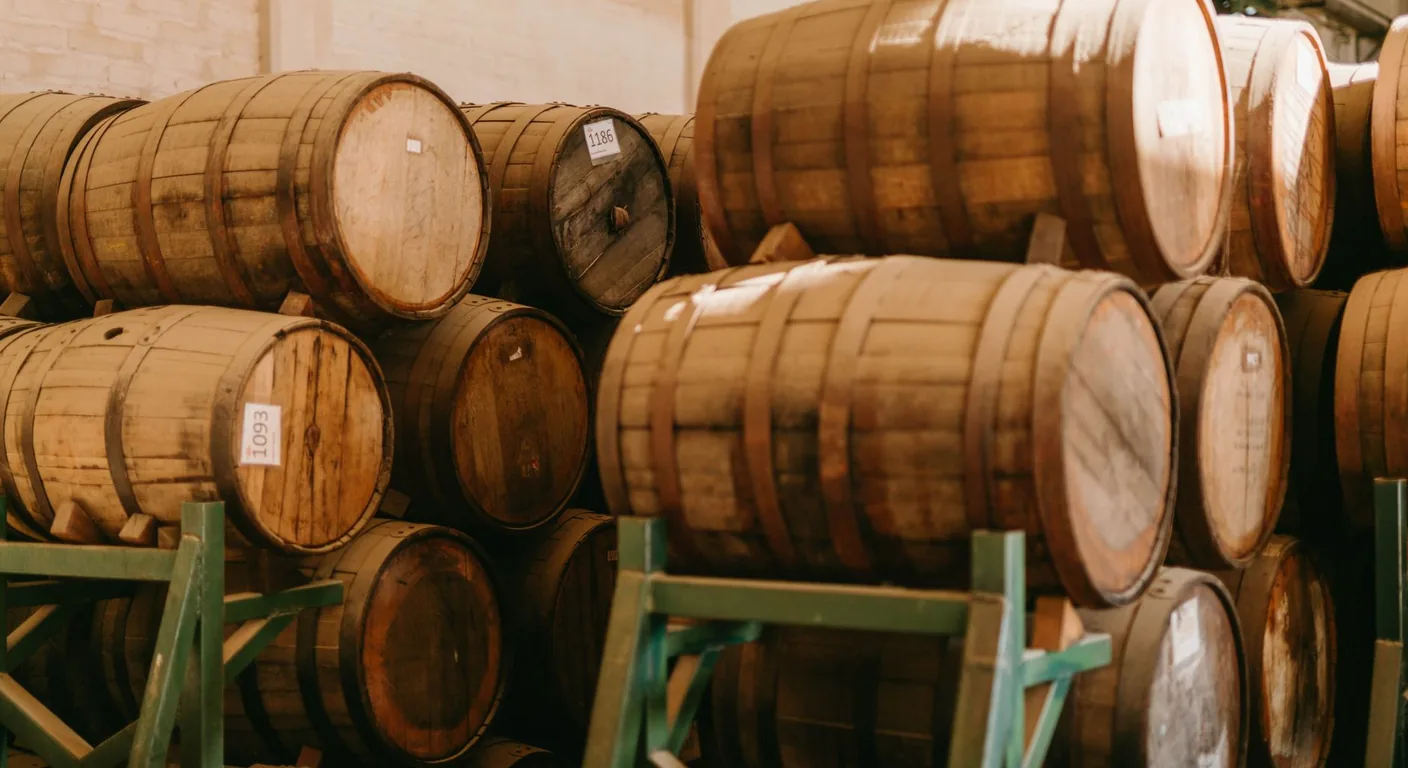
Bourbon does not just cost money to make. It costs money to sit. When you place a barrel in the rickhouse, it begins accruing storage costs immediately. This is a unique challenge for whiskey producers compared to brewers or clear spirit distillers who turn over their inventory in a matter of weeks.
Aging costs include the lease or depreciation on the warehouse, climate control utilities if you heat cycle your buildings, and the labor required to move, stack, and sample barrels. Warehousing methodology matters here. Palletized storage might require fewer labor hours to move, while traditional ricking requires specialized labor to extract specific barrels. Proper barrel management means tracking exactly where each barrel lives and how much maintenance it requires over its lifetime. Routine leak detection walks are a labor cost that belongs in the storage category. You may also incur costs for barrel maintenance. If a stave shrinks and requires a cooper to perform repairs, that specialized labor and material cost attaches to that specific barrel.
Insurance is another major factor in your storage calculation. As your whiskey ages and matures, its replacement value naturally increases. Higher value means your insurance premiums will rise year over year. In addition, many jurisdictions assess property taxes on aging spirits. These carrying costs must be allocated to the barrels. This adds to their total cost every month they remain untouched in the rack. A barrel that sits for eight years will have a vastly different cost profile than a barrel dumped after four years, even if their initial production costs were identical.
Calculating yield and the cost of the Angel's Share
A barrel of bourbon does not hold the same amount of liquid on day one as it does on year four. The natural evaporation known as the Angel's Share means you will lose a percentage of your volume every year the barrel sits in the rickhouse. Depending on your local climate, warehouse position, and barrel quality, this loss can be substantial over the lifespan of the spirit.
When figuring out how to calculate the true cost per barrel of bourbon, you have to project your final yield. A proof gallon is defined as one liquid gallon of spirits that is fifty percent alcohol by volume at sixty degrees Fahrenheit. Because volume fluctuates with temperature, you must apply temperature corrections when gauging to ensure your cost calculations are based on accurate proof gallons. If you put 53 gallons into a barrel at 125 proof, you are starting with roughly 66 proof gallons. After four years, you might lose a significant portion of that volume to the atmosphere. The upfront cost of production did not change, but the number of proof gallons you have available to sell has decreased.
This dynamic is what drives up your final cost per proof gallon. All the accumulated costs of raw materials, labor, overhead, and multi-year storage are now divided by a smaller number of gallons. You must perform regular barrel sampling and gauging to monitor these losses. Waiting until dumping day to discover you lost half your volume will destroy your financial projections and leave you scrambling to reprice your finished goods. Furthermore, catastrophic barrel failures where a stave breaks and the entire contents are lost must be accounted for in your overall financial modeling.
Why are TTB compliance and gauge reports so critical?
Accurate cost tracking goes hand in hand with federal reporting and compliance. The Alcohol and Tobacco Tax and Trade Bureau requires detailed records of your production, storage, and processing accounts. Keeping your proof gallon calculations precise is necessary for both tax compliance and your internal cost accounting.
According to federal regulations detailed at https://www.ecfr.gov, distilleries must accurately gauge and record spirits when they are entered into storage and when they are removed for processing or bottling. Federal excise taxes are levied based on proof gallons. If your internal tracking is sloppy, you risk overpaying taxes on evaporated liquid or facing audits for underreporting.
Please note that this is general information for distillery operations and does not constitute formal tax or legal advice. Always consult with a compliance professional or legal counsel for your specific reporting requirements.
When you pull a barrel for dumping, the final gauge of that barrel dictates the proof gallons you report. If your cost accounting does not align with your physical inventory, you will struggle to determine your true gross margin. Integrating your federal reporting data directly with your financial cost data ensures that your tax filings and your profitability metrics are always telling the same story. Review our TTB reporting guide for more strategies on keeping your records clean.
Formulating the final cost per proof gallon
To find your true cost per barrel, your mathematical formula must combine all the distinct elements we have discussed into a single ledger. Your total cost calculation should summarize four main pillars of distillery finance.
First, calculate direct materials. This includes your grain, yeast, enzymes, water treatment, and the fully delivered cost of the oak barrel.
Second, add your burdened direct labor. This must be specifically allocated for the exact production run that filled the barrel, including cleaning, maintenance, and sanitation time.
Third, include your production overhead. Apply the proper percentages for utilities, rent, maintenance parts, and equipment wear based on your total production volume for that month.
Finally, add your cumulative carrying costs. This accounts for warehouse space, insurance, property taxes, and labor for the entire time the barrel spent aging in the rickhouse.
Once you have that massive total, divide it by the actual number of proof gallons you harvest from the barrel at the end of its life. That final number is your true cost per proof gallon. You will use this number to determine the final cost of the liquid in the bottle. Only when you know this number can you confidently price your bottles for wholesale distribution and retail sales without sacrificing your margin.
Streamlining your cost accounting with Spirit Sight
Tracking these moving parts on offline spreadsheets becomes overwhelming as your barrel inventory grows from tens to thousands. Trying to manually update insurance costs, overhead allocations, and evaporation estimates across multiple years of production is a recipe for accounting errors and lost profits. A broken formula on a spreadsheet can lead to months of mispriced inventory.
Spirit Sight is an enterprise resource planning system built specifically for the daily, complex needs of distilleries. Our software automatically rolls up your raw materials, labor, overhead, and aging costs into a true, real-time cost per barrel. By replacing disconnected spreadsheets with a unified system, Spirit Sight gives you the clear financial visibility you need. You can see exactly what each proof gallon costs on any given day, empowering you to run a highly profitable and compliant distillery.
Key takeaways
- Include freight, taxes, and handling fees when calculating the true material cost of your grain and new charred oak barrels.
- Calculate labor by using fully burdened hourly rates that cover payroll taxes, benefits, and insurance alongside base wages.
- Allocate facility overhead based on the actual square footage and utilities dedicated exclusively to your active production floor.
- Account for the rising cost of insurance and property taxes as the replacement value of your aging whiskey increases over time.
- Remember that the final cost per proof gallon rises significantly over time due to the volume lost to natural evaporation during aging.
Frequently asked questions
How do you calculate the true cost per barrel of bourbon?
You calculate the true cost by summing your direct materials, burdened labor, production overhead, and cumulative storage costs, then dividing that total by the final number of proof gallons harvested.
What is considered production overhead in distilling?
Production overhead includes utilities like electricity and gas, depreciation of distilling equipment, cleaning chemicals, wastewater management, and the portion of rent allocated to the production space.
Why does evaporation increase the cost per proof gallon?
Natural evaporation reduces the total volume of liquid in the barrel. Because the accumulated production and storage costs remain the same, dividing those fixed costs by fewer remaining gallons yields a higher cost per gallon.
Do insurance costs change as bourbon ages?
Yes. As whiskey matures, its replacement value increases, which typically results in rising insurance premiums for the barrels stored in your rickhouse.