In short: Evaporative barrel loss, commonly called the angel's share, directly drives up your true cost per proof gallon over time. By tracking these losses at the barrel level, distillers can accurately forecast yields, maintain strict TTB compliance, and properly price their spirits to protect long-term profit margins.
Every distiller knows the phrase. Few can tell you on any given day what the angel's share is actually costing them this quarter. It often gets treated as industry folklore, a charming tradition of whiskey making. Then, it shows up as a significant financial surprise when the barrels come down from the rickhouse much lighter than the accounting spreadsheet assumed.
Evaporative loss is a physical reality that is highly measurable. It follows distinct environmental patterns. Once you start tracking it at the individual barrel level, it becomes something you can forecast, model, and price around. When you stop treating maturation loss as a mystery and start treating it as a standard inventory metric, your distillery gains a massive advantage in financial planning and pricing strategy.
What exactly drives the physical loss in your barrels?
Before you can account for the financial cost of the angel's share, you have to understand the physical mechanics that cause it. The headline figure, often loosely cited as a few percent of volume per year, hides most of what actually matters.
Whiskey barrels are porous. Oak expands and contracts as the seasons change, pulling the liquid into the wood and pushing it back out. During this maturation cycle, liquid evaporates through the staves. The two primary components of your resting spirit are water and ethanol. Because water molecules and ethanol molecules are different sizes, they evaporate at different rates depending on the surrounding environment.
When a barrel sits in a dry environment, water, which has a smaller molecule size, escapes through the oak faster than the ethanol. As a result, the overall volume inside the barrel decreases, but the proof of the remaining liquid actually goes up. Conversely, in a very humid environment, the moisture in the air slows down the evaporation of water. In these damp conditions, the ethanol evaporates faster than the water. The total liquid volume drops, and the proof drops right along with it.
A single annual percentage smooths away the severe swings you actually need to plan against. If you average your loss into one generic rate across your entire operation, you lose the ability to explain or anticipate what any specific barrel will yield when it is finally time to bottle.
How does rickhouse location change the math?
The location of a barrel inside your rickhouse is just as important as the climate outside of it. Not all barrel positions are created equal. Evaporative loss varies dramatically depending on where a barrel rests.
Heat rises. In a traditional, unclimate-controlled rickhouse, the upper floors run significantly hotter than the ground floor. The roof of the warehouse bakes in the summer sun, turning the top tiers into a dry, high-temperature environment. Barrels stored on the top floors experience aggressive evaporation. They lose volume rapidly, and their proof can skyrocket.
Meanwhile, the bottom floors remain cool, shaded, and damp. Barrels resting near the dirt or concrete floor experience much slower evaporation. Their proof might remain perfectly stable over four years, or it might even slowly decrease.
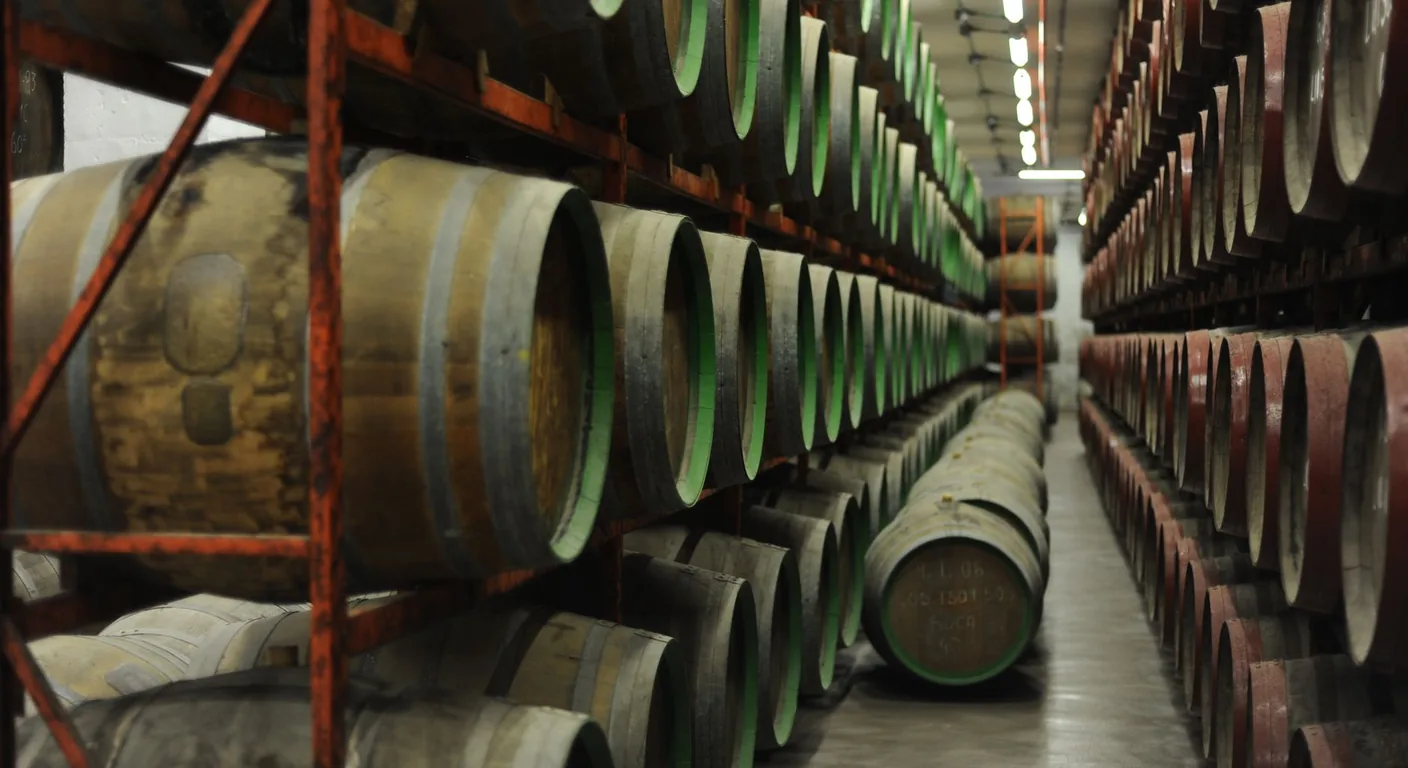
Two barrels filled on the exact same day, from the exact same distillation batch, at the exact same entry proof, will diverge wildly if one is placed on the first floor and the other on the sixth floor. If your distillery uses a robust management system, such as the tools found in our barrel tracking module, you can record the exact warehouse, floor, and tier for every single cask. This precise location data is the missing link that allows you to predict your true yield. Different rickhouse styles also play a role. Palletized warehouses provide a different airflow and temperature gradient than traditional tiered rickhouses. Tracking this data over time reveals the unique microclimates of your specific storage facilities.
Why does this belong on your financial books?
The angel's share is a real, tangible cost of goods sold. The spirit that evaporates into the atmosphere was made from grain you bought. It was distilled using energy you paid for. It was fermented using yeast you purchased, by employees on your payroll. It is currently being stored in a white oak barrel that is itself a depreciating asset.
Every drop of liquid that vanishes takes a fraction of those sunk costs with it. When a barrel yields fewer proof gallons than you initially planned, your true cost per proof gallon on the liquid that remains goes up.
Imagine you fill a standard barrel at an entry proof that yields 60 proof gallons. Let us assume your total production cost is $300. This encompasses raw materials, labor, utilities, and the barrel itself. At the time of fill, your base cost is $5.00 per proof gallon.
Four years later, you pull that barrel down from the third floor. Due to the angel's share, the barrel now only holds 45 proof gallons. Your original $300 production cost has not decreased. In fact, it has likely increased once you factor in storage overhead, insurance, and property taxes over those four years. But sticking strictly to the original $300, your cost has now jumped to $6.67 per proof gallon. That is a 33 percent increase in your baseline cost.
If that volume reduction is not flowing into your distillery accounting software, then your cost per barrel, your margin by release, and your wholesale pricing are all working from a volume that no longer exists. The number you are selling against is pure fiction. It is off by exactly the amount the angels took. Properly allocating these costs allows you to set a wholesale and retail price that actually protects your intended profit margin.
How does the TTB handle evaporative loss?
The financial implications of the angel's share extend directly to your tax compliance. The Alcohol and Tobacco Tax and Trade Bureau monitors spirit production strictly. Every proof gallon must be accounted for from the moment it comes off the still to the moment it leaves your bonded premises in a bottle.
Under the Code of Federal Regulations, specifically 27 CFR Part 19, the government establishes rules for how distilleries must track and report inventory. You can review the exact statutes directly at https://www.ecfr.gov or find compliance guidance at https://www.ttb.gov.
The good news is that the TTB understands the mechanics of barrel aging. They classify the angel's share as a normal storage loss. You are not required to pay federal excise tax on the spirits that evaporate naturally during the maturation process, provided those losses are properly documented and fall within expected parameters.
However, the government expects accurate record keeping. You cannot simply guess your losses or apply a flat rate. You must physically gauge the barrel to claim the loss officially. Until a barrel is regauged or dumped, the TTB assumes the original fill volume is still sitting inside the barrel. If you do not conduct interim regauges, your theoretical tax liability remains artificially high until the day the barrel is emptied.
It is also critical to distinguish between normal evaporative loss and abnormal loss. If a barrel springs a leak, breaks open, or is stolen, that is considered an abnormal loss under 27 CFR Part 19. Abnormal losses require immediate reporting and different tax treatment. Please note that this is general regulatory information for educational purposes and does not constitute formal legal or tax advice.
Properly managing your TTB reporting ensures that you are only paying taxes on the spirits you actually bottle and sell, rather than the spirits that drifted out of the warehouse vents.
Why does barrel loss affect insurance and valuation?
Beyond cost of goods sold and tax liabilities, the angel's share directly impacts your insurance policies and your balance sheet valuation. Maturing whiskey is often the most valuable asset a distillery owns.
When you insure your barrel inventory, you must provide the underwriter with a valuation of the liquid currently resting in your warehouses. If your inventory valuation assumes zero evaporative loss over five years, you are actively over-insuring your volume and overpaying on your insurance premiums. You are literally paying to insure liquid that evaporated three years ago.
Conversely, if you write down the volume loss but fail to account for the increased market value of the aged spirit, you run the risk of under-insuring your assets. A five-year-old barrel holds less liquid than a new-make barrel, but the liquid inside is worth significantly more per gallon due to time, storage costs, and market demand for mature spirits. A modern distillery needs an accurate, real-time snapshot of both the diminished volume and the appreciated value of every barrel on the property. Your commercial insurance carrier will expect documentation to support your claimed replacement value in the event of a catastrophic loss. Accurate barrel tracking gives you this documentation, preventing a disastrous shortfall during the claims process.
How do you turn folklore into a financial forecast?
The path from industry legend to accurate financial forecasting is straightforward in principle, though it requires strict operational discipline to execute. Distilleries that master this process generally follow a four-step framework:
- Gauge and record meticulously. You must record the exact proof, gross weight, tare weight, and net volume at the time of fill. Perform interim regauges on a representative sample of barrels from different locations in the warehouse to check their progress.
- Attribute the loss to specific variables. Do not just record that a barrel lost ten gallons. Record that a barrel on the fourth floor, during the summer, aged for four years, lost ten gallons. Capturing position, age, and seasonal conditions makes the evaporation pattern highly visible.
- Project yields forward. Once you have historical data, you can build predictive curves. You can look at a batch of barrels on the first floor and accurately estimate their yield two years from now. This predictive power allows you to commit to future distributor orders with absolute confidence.
- Feed data into your costing models. The reduced volume must automatically update your cost per remaining proof gallon. This ensures that your profit margin reflects reality before you ever set a wholesale or retail price.
Managing maturation with specialized distillery software
Trying to track the nuances of evaporative loss across hundreds or thousands of barrels using generic spreadsheets is a recipe for broken formulas and compliance headaches. The variables are simply too complex to manage manually over a multi-year aging cycle. Between fluctuating proofs, varying warehouse microclimates, and compounding carrying costs, an off-the-shelf spreadsheet will eventually fail.
When you capture this data correctly, the angel's share stops being a frustrating year-end write-down that you have to explain to your investors after the fact. It becomes a standard line item that you forecast, a physical loss you can pinpoint to a specific warehouse floor, and a direct mathematical input into how you price every single release.
Spirit Sight tracks proof and volume at the individual barrel level through the full maturation lifecycle. It models evaporative loss against warehouse position and time. It carries the resulting data directly into your barrel valuation and costing workflows. By integrating these metrics, the volume number you plan your business against is always the exact number that is actually resting in the rickhouse.
Key takeaways
- Evaporative loss fluctuates based on rickhouse location and climate, making generic average loss percentages dangerous for financial planning.
- The angel's share reduces total barrel volume while baseline production costs remain static, directly inflating your cost per proof gallon.
- Under 27 CFR Part 19, the TTB treats standard evaporation as a normal storage loss, exempting the lost volume from federal excise tax if properly recorded.
- Accurately tracking barrel loss helps distillers avoid overpaying on insurance premiums and ensures the balance sheet reflects true liquid valuation.
- Implementing an enterprise distillery management system allows you to forecast mature yields, ensure precise tax compliance, and protect wholesale profit margins.
Frequently asked questions
What causes the proof to go up or down during barrel aging?
Proof changes based on ambient humidity and temperature. In hot, dry conditions, water evaporates faster than ethanol, causing the proof to rise. In cool, humid conditions, ethanol evaporates faster than water, causing the proof to fall.
Do I have to pay federal excise tax on the angel's share?
No, the TTB classifies natural evaporation as a normal storage loss under 27 CFR Part 19. You do not owe excise tax on this lost volume as long as the loss is accurately gauged, documented, and reported during a regauge or dump.
How does evaporative loss impact my cost of goods sold?
Because your initial production costs are fixed, losing volume to evaporation means those same costs are spread across fewer remaining proof gallons. This mathematically increases your cost per proof gallon, lowering your profit margin if you do not adjust pricing accordingly.
Why is it important to track barrel location in the rickhouse?
Different floors and tiers experience distinct microclimates. Barrels on upper floors typically lose volume much faster than those on lower floors. Tracking location allows you to accurately predict yield and plan your blending profiles based on where the barrel matured.