In short: Water source and treatment for distilleries impacts every stage of production, from yeast health during fermentation to the clarity of the final bottled spirit. Effective water management protects steam boilers from mineral scale, ensures accurate TTB proofing, and prevents costly municipal wastewater fines.
Getting your water source and treatment for distilleries dialed in is just as critical as selecting the right grain bill or yeast strain. Whether you are pulling from a municipal city line or a private well, water makes up the vast majority of your final bottled spirit and serves as the lifeblood of your heating and cooling systems. Understanding how to properly filter, treat, and gauge your water protects your expensive equipment, ensures healthy fermentations, and prevents cloudy spirits in the bottle.
Why does water source and treatment for distilleries matter?
Distilleries use water in three distinct operational areas. First, it is a core ingredient in mashing and proofing. Second, it is a utility fluid for boiler steam and condenser cooling. Third, it is required for cleaning, sanitation, and rinsing equipment between batches. Each of these applications demands a different level of water quality and specific treatment methods.
If you are operating on a municipal water supply, your primary enemy is chlorine or chloramine. City water facilities use these chemicals to kill bacteria, but they will also stunt your yeast and create medicinal, plastic-like off-flavors during fermentation. If your distillery relies on well water, you might face high levels of iron, manganese, or sulfur. These minerals can severely impact the flavor of your whiskey or rum. High iron levels can actually turn a spirit black or green when the iron reacts with the tannins extracted from an oak barrel.
Treating water is never a one-size-fits-all process. You will likely need a multi-stage system that includes sediment filtration to catch large particulates, activated carbon to strip out municipal chlorine, and a reverse osmosis system to create a completely blank slate for proofing. Managing these systems properly ensures your product remains consistent from batch to batch, which is the ultimate goal for any growing spirits brand.
How does water chemistry affect stills and boilers?
Before water ever touches your grain, it runs through your utility equipment. Most mid-size and expanding distilleries rely on steam-driven systems. As many experienced distillers note, the cost gap between a 125-gallon and a 500-gallon steam still is minimal compared to the overall cost of the boiler and facility plumbing. However, feeding hard water into a steam boiler is a recipe for expensive equipment failure.
Hard water contains dissolved calcium and magnesium. When this water is heated to create steam, those minerals are left behind, forming a hard, chalky scale on heating elements and internal boiler walls. This scale acts as an insulator, forcing your boiler to work much harder, consume more energy, and eventually burn out. Rebuilding a scaled-up boiler or replacing heavily scaled cooling jackets requires significant downtime and capital. Most boiler manufacturers strictly require a water softener and specific chemical treatments to prevent scaling and corrosion.
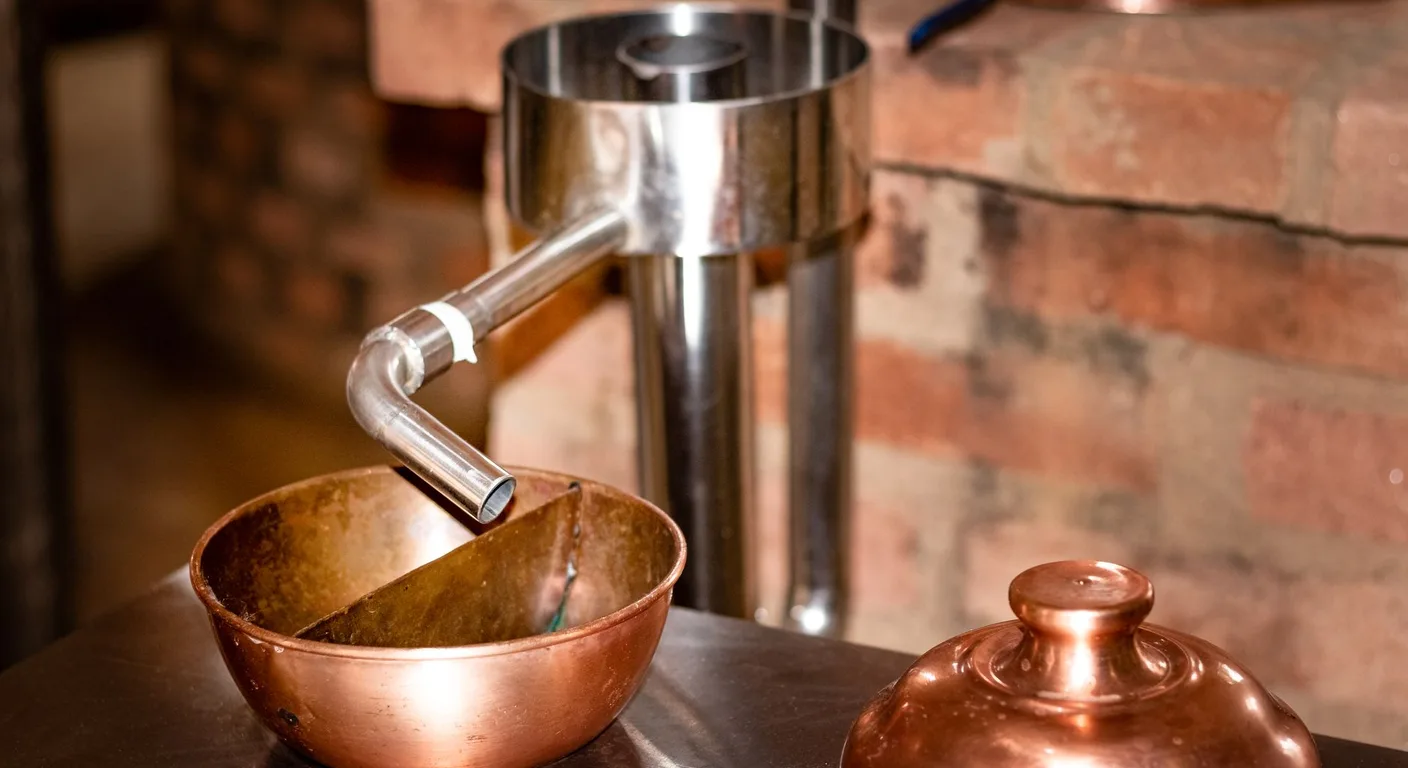
Your cooling water loop also requires close attention. A dedicated stripping still can produce roughly double the output of a finishing still in the same amount of time, but it requires a massive amount of cooling water to knock down that vapor. Copper on the hot side of your still acts as a catalyst to remove sulfur compounds, producing a softer spirit. However, in the cooler distillate path like the condenser and spirit pipe, the copper benefit largely disappears. Stainless steel is a more durable and easier-to-clean choice for those cold-side components. Regardless of whether you use copper or stainless steel, running hard water through a condenser jacket will eventually form an insulating scale, drastically reducing its cooling efficiency.
What is the best water treatment for mashing and fermentation?
A whiskey wash is essentially a beer without hops. Because of this, you can often use brewery equipment like temperature-controlled fermenters and dedicated mash tuns. However, the water you put into that mash tun needs specific chemical characteristics to succeed.
Mashing requires water that supports enzymatic conversion and healthy yeast growth. Yeast needs trace minerals, particularly calcium and zinc, to reproduce and ferment efficiently. If you use completely pure reverse osmosis water for your mash without adding any minerals back, your yeast will struggle, leading to stuck fermentations, elevated off-flavors, and low alcohol yields.
For mashing, the most common treatment is simple carbon filtration. Passing municipal water through a large activated carbon filter removes the chlorine and chloramines that harm yeast, while leaving the beneficial calcium and magnesium intact. If your local water is exceptionally hard or alkaline, you may need to blend carbon-filtered water with a percentage of reverse osmosis water, or use a food-grade acid to lower the pH of your mash water to the ideal range of 5.0 to 5.5. Some startups try to use their still as a mash tun to save money on equipment. While possible, it ties up your most expensive piece of equipment and usually lacks the cooling jacket and proper paddle agitator needed to cool the mash quickly. Getting your mash water chemistry and temperature control right ensures a vigorous fermentation, maximizing the alcohol you can extract from your grain.
How do you treat water for proofing and bottling?
The water you use to dilute your spirit from barrel strength down to bottling strength must be impeccably clean. This is where reverse osmosis and deionization become absolutely mandatory for quality control.
When you pull a whiskey from a barrel, it contains dissolved lipids, fatty acids, and complex flavor compounds. At barrel strength, these compounds remain entirely dissolved in the alcohol. When you add water to lower the proof, the concentration of alcohol drops. If you use water that contains calcium, magnesium, or other minerals, those minerals will bind with the fatty acids in the spirit. When the spirit gets cold, this binding causes flocculation, which appears as an unappealing cloudy haze in the bottle.
To prevent this, proofing water must be stripped of all minerals. A commercial reverse osmosis system pushes water through a semi-permeable membrane, removing up to 99 percent of dissolved solids. Some distilleries go a step further and use a deionization resin to achieve absolute zero parts per million of dissolved solids. Using ultra-pure water ensures that your spirit remains brilliantly clear on the shelf. If you do not use demineralized water, you may be forced to rely on chill filtration to remove the flocculation. Chill filtration involves cooling the spirit down to near freezing and forcing it through tight paper or pad filters. Many craft distillers prefer to avoid chill filtration because it can strip out desirable mouthfeel and flavor compounds. When calculating how much of this treated water to add to reach your target proof, utilizing a reliable dilution calculator helps prevent over-dilution, saving you from costly mistakes during the blending process.
TTB compliance, gauging, and water addition
Every drop of water you add to a spirit impacts your regulatory reporting and your tax liability. The Alcohol and Tobacco Tax and Trade Bureau strictly governs how spirits are measured, proofed, and taxed.
When you dump barrels for a batch, you are dealing with bulk spirits at a specific proof. Adding water increases the total wine gallons but keeps the total proof gallons exactly the same. Your excise tax is based on those proof gallons. A proof gallon is one liquid gallon of spirits at 60 degrees Fahrenheit that is 50 percent alcohol by volume. When you add reverse osmosis water to a barrel-strength whiskey, the proof drops, but the absolute volume of pure alcohol remains constant.
Accurate gauging before and after water addition is a strict federal requirement. According to the TTB Gauging Manual outlined in 27 CFR Part 30, you must use certified hydrometers and thermometers to determine the exact proof of your spirits, correcting for temperature variations. Please note that this is general information and does not constitute tax or legal advice.
Errors in gauging your water additions can lead to significant compliance issues. If you over-dilute a batch and bottle it below the proof stated on your approved label, you are out of compliance. If you under-dilute and bottle it at a higher proof than stated, you are underpaying your excise taxes, which can trigger severe penalties during an audit. Managing these precise measurements across multiple batches is where robust distillery management software becomes invaluable, automatically calculating temperature corrections and tracking your proof gallon inventory accurately.
Factoring water treatment into your cost of production
Water is often viewed as a cheap, limitless utility, but the cost of treating and managing it must be factored into your true cost of production. Reverse osmosis membranes need replacing, carbon filters require backwashing and media swaps, and boiler chemicals represent an ongoing operating expense that scales with your production volume.
Furthermore, cooling water and wastewater discharge can heavily impact your monthly utility bills. Many municipalities charge commercial rates not just for the water you consume, but for the wastewater you send down the drain. Because distillation requires high volumes of cooling water, operating a single-pass cooling system where water goes straight from the city main, through your condenser, and down the drain is incredibly expensive and wasteful.
Investing in a closed-loop chiller system or a cooling tower reduces your water consumption drastically. You must also account for the volume of stillage left in the kettle after running your stripping still. Discharging highly acidic stillage with a high biological oxygen demand directly into city sewers can trigger massive municipal fines. Treating your wastewater by neutralizing the pH and settling out solids is a critical step in distillery water management. By tracking all of these utility and treatment costs, you gain a highly accurate picture of your actual cost per barrel, allowing you to price your wholesale and retail products for sustainable profitability.
Spirit Sight provides a comprehensive distillery management system designed to track every aspect of your production, from grain intake to the final bottled spirit. By integrating your daily processing operations, gauging records, and overhead utility costs into one platform, Spirit Sight helps you maintain precise control over your yields and compliance. Knowing your true production costs and keeping flawless TTB records allows you to focus on the craft of distillation, confident that your back office is operating as smoothly as your treated water systems.
Key takeaways
- Hard water scales steam boilers and cooling jackets, leading to increased energy costs and expensive equipment rebuilds.
- Mashing requires carbon-filtered water that retains trace minerals like calcium and zinc to support healthy yeast fermentation.
- Proofing requires reverse osmosis or deionized water to prevent minerals from binding with spirit lipids and causing cloudiness.
- Adding water to a batch requires precise temperature and hydrometer readings to accurately report proof gallons to the TTB.
- Wastewater treatment and closed-loop cooling systems are necessary to avoid high municipal water bills and discharge fines.
Frequently asked questions
Can I use tap water to proof my whiskey?
Using untreated tap water to proof whiskey is not recommended. The calcium and magnesium in tap water will bind with the fatty acids in the spirit, causing an unappealing cloudy haze known as flocculation.
Why is reverse osmosis water bad for mashing?
Reverse osmosis strips all minerals from the water, including the calcium and zinc that yeast need to reproduce. If you use reverse osmosis water for mashing, you must add vital minerals back to avoid stuck fermentations.
Does adding water to spirits change my TTB excise tax?
Adding water increases your total wine gallons but does not change your total proof gallons. Because TTB excise tax is based on proof gallons, diluting your spirit does not change the total tax owed on that batch.
How does hard water affect my distillery equipment?
Hard water leaves behind calcium and magnesium deposits when heated, forming an insulating scale on steam boiler elements and cooling condenser jackets. This scale forces equipment to work harder and can cause premature failure.